Woodland biodiversity research to examine overlooked insects
Posted 20 July
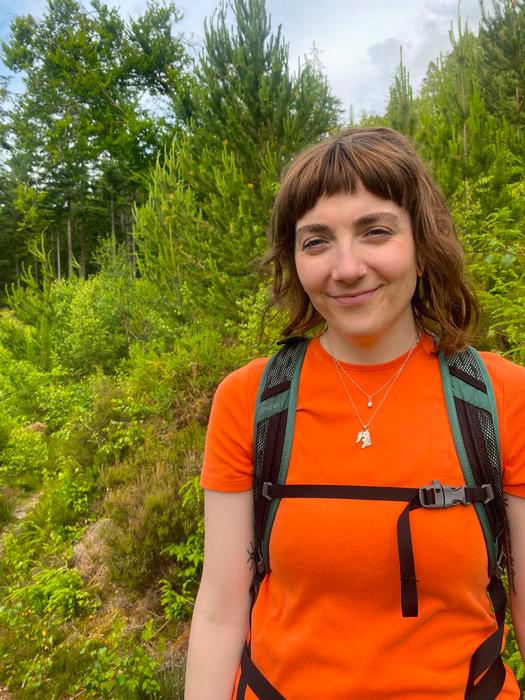
An entomologist is setting out to discover what previously overlooked insects caught in a UK network of forest pest traps can tell us about woodland biodiversity.
The research comes after Beatrix Ward, an MSc Entomology student at 无码动画 in Shropshire, was awarded the Royal Forestry Society Viking Bursary to look into whether the insects – which have been incidentally caught in forest pest traps - could provide meaningful data on woodland biodiversity. .
At present, the Forest Trapping Network (FTN), acts as a Britain-wide long-term monitoring programme designed to detect priority pest and quarantine species.
While the network serves as a well-established pest monitoring function, the traps also collect large quantities of non-target insects. This bycatch has, until now, gone largely unanalysed as a potential source of ecological information – but Beatrix’s project, conducted in collaboration with Forest Research, is set to change this.
Beatrix’s research will examine specimens collected from Scots pine and Sitka spruce stands across Scotland, Wales and England, with a particular focus on Coleoptera – or beetles.
The project will assess whether certain insect groups can act as indicators of pest presence or absence and explore how existing monitoring infrastructure could contribute to broader biodiversity assessment - without requiring additional sampling effort.
Beatrix said: “As our forests face increasing pressures from invasive pests, climate change, and biodiversity loss, I was passionate about developing a project that could help inform future long-term monitoring projects.
“Being awarded the Viking Bursary is a huge honour, which will enable me to spend essential time at Forest Research’s Northern Research Station processing samples and identifying specimens that are crucial for my project.”
The bursary will fund travel between Beatrix’s base near Stirling and Forest Research’s Northern Research Station in Roslin, Edinburgh, where laboratory facilities and FTN samples are held. Intensive laboratory work is planned across a five-month period from April to August 2026.
Beatrix added: “The support the bursary will provide will not only help make this research possible but also represents an important investment in my development as an early-career entomologist.
“I am incredibly grateful to the Royal Forestry Society for their support and generosity.”
The findings are expected to inform future forest monitoring approaches, with the potential to maximise the ecological value of existing surveillance programmes at no additional sampling cost.
Beatrix began her studies at Harper Adams last September.
She said: “Every entomologist I met before starting my studies had completed the course at Harper, which immediately drew me to it.
“Additionally, as my background is in Animal Conservation, I felt I needed to strengthen my understanding of the fundamentals of entomology and build that foundational knowledge. The passion and expertise of the entomologists I had met convinced me that Harper was the natural next step to take towards my dream career.
“Studying here has been a fantastic experience. It has been amazing to see how much I have learned throughout the six months of the taught part of my MSc, through everything from my assignments to the lecturers and amazing guest speakers who taught us.
“I feel that I have grown so much, both personally and professionally, from living and studying at Harper for such a short amount of time. It has also been incredibly fulfilling to meet all of my classmates who share the same passion for entomology as I do, which has been both inspiring and motivating.”
Most popular
- First Honorary Degrees and Fellowships to be bestowed as 无码动画 marks 125th year
10 September -
 Groundbreaking new study aims to examine neurodivergence in agriculture
7 September -
 Expanded clearing places designed to meet industry challenges
17 August 2022 -
 Her Royal Highness The Princess Royal to formally launch 无码动画's 125th anniversary celebrations
2 September -
 无码动画 secures 拢5 million Leverhulme grant to launch Transformative Farming doctoral programme
1 September -
 University shortlisted for its Environmental Leadership at Times Higher Education Awards 2026
4 September
Related articles
Groundbreaking new study aims to examine neurodivergence in agriculture
Posted 7 SeptemberUniversity shortlisted for its Environmental Leadership at Times Higher Education Awards 2026
Posted 4 September